Friday, February 19, 2021

Initiation into Afro- Caribbean and Taino traditions

Initiation into Afro- Caribbean and Taino traditions

When Ni Bon Te Ban was first presented to Palo Nkisi (Fundamento) back in 1988, access to our Spiritual traditions was through word of mouth, extended family, neighbors and so on. It was clear that if one found oneself in front of Fundamento, one clearly had a destiny within, if not Palo, then within one of our sister traditions within the Caribbean. While this did limit who could find their way to Fundamento or Zemis (Taino Nkisi), it did simplify the process of finding an elder. For good or bad, your elder was your elder, and you could not just go out and "shop" for a new one. We reflect back on this process, because today our traditions and specifically INITIATIONS are marketed heavily on social media, radically changing the process of finding an elder.  

When Guariche Kao first sat with Ni Bon Te Ban for a divination in May, 2000, he asked her "who brought you here?"  She replied with the usual response, pointing to the person who had told her about Ni. "No!" Ni replied. "Spirit brought you here, your Ancestors brought you here!" At the time the internet was in its infancy and very few books were readily available concerning Palo, and only few concerning Taino. The idea of shopping for an elder had not yet manifested. There was a clear understanding that DESTINY had brought one to the mat. 

Destiny brought Ni to Tata Justino back in 1988. Destiny brought him to the elder (who we will just call JV at this time) who initiated him back in 1995 into a Briyumba line of Palo. Justino was a Tata of integrity, love and great wisdom, who sadly (for us) returned to our Ancestors soon after Ni met him. Meanwhile destiny brought Ni to a crossroads with the newly emerging Taino resurgence in 1989 in NYC with L'Association Indigena Taino (which later split into La Nacion Taino de las Antilles and Maisiti Yucayeke Taino).

In sharp contrast, Tata JV was petty, vicious, and completely lacking integrity. In today's environment, Tata JV would have been thrown to the side and another elder sought out. However the 90s were a lifetime away from where we stand now. Now we can all fact check or get a second, third or fourth opinion on social media, back then, we had to figure it out ourselves. The spiritual battle that Ni had with JV was an epic one, which perhaps one day we will share in its own book. Looking back, we cannot deny it was destiny for us to fight that spiritual battle to its conclusion. It contributed greatly to making us who we are today. As per the Lucumi proverb "Your enemy will do you evil, your enemy will do you good", this irony, or apparent contradiction, is woven deeply through many aspects of life. 


A strange trait of destiny, is that when one comes upon those crossroads, nodes of destiny, there can be an overwhelming desire to run away from them.  After all, physical death, is destiny, one that we find incredibly hard to prepare for and deal with and which we would rather avoid. 

Many people are initiated into Afro-Caribbean traditions, especially now with the resurgence of interest and increasing social acceptability of our traditions. It is even "trendy" to be initiated these days. These initiations which are being marketed on social media, range from being legitimate initiations with responsible elders, to being diluted initiations, to being down right fake. It can be very difficult determine one from the other with all the dust in the air. Those with an experienced eye can easily tell the difference, but for those who have little experience, it is not so easy.

Let us assume that one does receive a legitimate initiation into one of our traditions. This does not insure that one has an elder of integrity. One's elder may pass to the Ancestral World, as Tata Justino did. Or one's elder may be using the Fundamento to manipulate, confuse and entrap, as Tata JV has done.  This does not mean that receiving the Initiation was in error. If one receives a legitimate initiation into one of our traditions, it was a destiny that emanated from the Ancestral realms, and should be valued as such. The spiritual battle that sometimes comes along with it should also be valued as destiny.  


When we knock on that door, we have no ability to foresee where that fateful decision will lead us. If we run away from what that door opens to, then either we ran away from our destiny or perhaps it was not our destiny to begin with and we should not have knocked on the door in the first place. Life is a Mystery and the human experience is cloaked far more in obscurity than illumination. As limited as our ability to see visible light on the entire spectrum of light, is our limitation inside of the human experience. Initiation opens the doors of our Vittiti, our spiritual vision. We can then choose to develop Vittiti, or to sink deeper into denial. 

Initiation is a rebirth, and just as a baby takes time to develop her ability to discern shapes and colors and understand what they are, the initiate takes time to be able to make sense of the new entities that they are sensing. Initiation is not a winning lottery ticket, it is not a guarantee of success, it is not an ego trip or an item on our resume. Initiation is an opportunity to express our best and highest and to embody our true selves.


Unlocking the Spiritual Power of Plants- Book to be published 2021


                        Unlocking the Spiritual Power of the Plants

                                        Our upcoming book
 2021

Our book, long in the writing, is taking its final shape, and we anticipate publishing it this year.  

The book is an in depth look into the spiritual powers of plants, understanding some of the most commonly used plants within our traditions, as well as a guide to unlocking the spiritual power of plants found in our "new" surroundings in the diaspora. 

We write from our perspective as Palo Kongo Taino, honoring our dual roots of Kongo and Taino (not negating European). We have combined 45 years of experience as initiated Paleros and elders of our Munanso. Spanning the Kalunga line, this book is both a dedication to our Ancestral Tree and to our Future Generations in the widest sense of the word "our" to also embrace "your".

The book also contains recipes for spiritual baths, incenses or smudges, Chamba, Wine, and more. We also discuss Nkisis or Zemi carved from plants.

We thank you for your patience.


Friday, December 6, 2019

DIA DE LOS BAKULU 2019 (in the absence of Denial!)

Dia de los Bakulu (Dia de los Muertos)
A Bakulu is an Ancestor who was able to achieve the state of expertise within the destiny of their Spirit.  They were able to truly fulfill their rite of passage (tratado), which is life, holding onto their principles and expressing their "best and highest".  A Bakulu is a very sacred Ancestor, one who embodies the greatest Wisdom and Love.  When we have the great blessing to know a future Bakulu, while they were still walking upon this Earth, their transition to the World of the Ancestors is both devastating and full of phenomenon.  The devastation is perhaps more of a function of the ignorance and fear that modern "society" has towards "death" in general.

On this Day of the Bakulu, we take a moment to reflect on this ignorance and fear that causes our many peoples to consent to the incarceration of the sacred bodies of their loved ones in concrete, filled with poisonous embalming fluid.  We take a moment to make an invocation for all those Spirits, who, upon leaving their human experience, find their former bodies treated with such disregard by a system that sees those bodies as a final payout, a final profit, from that person's life.  We also take a moment to reflect that our Taino Ancestors kept their loved one's remains within their Bohios (homes) hanging in a gourd from the ceiling or buried beneath the floor. Perhaps the devastation arises more from the memories of our Spirits, who remember how closely we held our Ancestors, who cry out in pain, seeing our loved one's bodies in a warehouse of corpses, lined up in rows, stacked up one on top of the other.

Is it possible to "celebrate" the "Day of the Dead" when we allow strangers to bathe our loved ones for the last time? To dress them for their final journey out of this physical world? When we consent to the draining of the blood from the body and that sacred substance discarded as "medical waste"? 

While Day of the Dead is a wonderful moment to acknowledge and honor the ancestors, does our responsibility end here? Have we ourselves considered, in a clear, honest way, our own inevitable transition to the World of the Ancestors?  How will we choose to make that transition? In denial? Leaving the hard decisions to our distraught and devastated family and loved ones? 

Over the years we have written extensively concerning the Day of the Dead and included many photos of the offerings that we give to the Sacred Ancestors, known and unknown. This year demands a different conversation, an honest assessment of how we, as Taino, as Paleros, as Spirits having a Human Experience, are allowing our loved ones, and ultimately ourselves, to make that momentous transition into the World of the Ancestors.  Are we empowering or disempowering our loved ones within that most significant ceremony of Life/Death?

A Bakulu will be able to manifest their continued influence within the Physical Realm- Here a double Rainbow

Here Eagles....


A couple resources for Home Funerals:
www.crossings.net (home funeral resource)
www.homefuneralalliance.org (national home funeral alliance)

Sunday, July 28, 2019

Walk in Nfinda 2019


A walk through the Nfinda, where we discus tratado!


Saturday, July 27, 2019

Conuco 2019 Part 3


The 3rd and final part of our Conuco/ Botanica walk.

Conuco 2019 Part 2


Part 2- Our Conucos, our Botanica!

Conuco 2019 Part 1


We give an update on our Conucos, Bateys and Nfinda. Lots of medicinal plants, lots of fruit, lots of trees are in our BOTANICA!!!! This is part 1 of 3.

Tuesday, November 6, 2018

Dia de los Muertos 2018

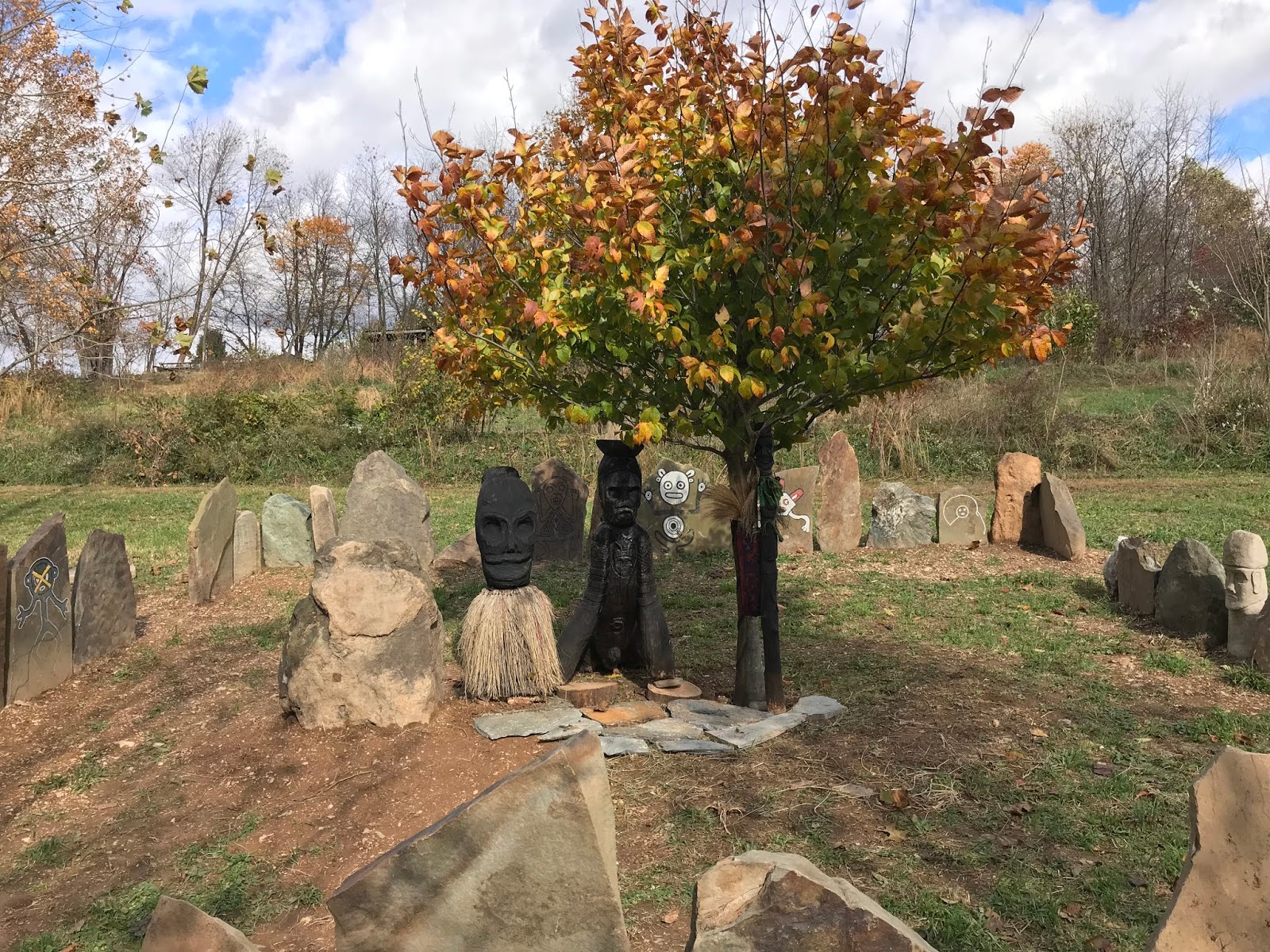
 Dia de los Muertos (Day of the Dead) accompanies a radical transformation, here in the temperate regions, when summer transforms to winter.  The leaves which have absorbed so much sunlight during the summer, now turn every shade of yellow, orange, red, and brown and fall to the earth to nourish the soil.  The tree trunks left reflect the palos within the fundamento, showing us how the Earth is one great big Fundamento with every palo imaginable within her.  This year we chose to make our Day of the Dead offerings in a new Batey that we are building for our son, Hatuey.  The tree in the center is his tree, planted when he was one years old, over his placenta.  The stones of the Batey itself are from an older Batey that was in the forest.  Everything changes and shifts, and shape shifts in life.
The cemis, Opiel Guabiran and Guatauba Maquetaurie, are present, representing the Taino ancestors. Various batons and palos are present representing ancestors, as well as various other elements of the ancestors.  The petroglyphs visible are all Taino petroglyphs.  While we are honoring "Day" of the Dead, in reality everyday for us is the "day of the dead".  As Nganguleros, Taino, we see the Dead as being instrumental, essential and present in every day movements.
Our offering consists of all the vital elements, cooked and raw, that can be absorbed by the ancestors.  The aromas are of particular importance in this process.  Cooking the food allows the aromas to be carried upon the winds in all directions, calling the ancestors to approach.  Essential elements such as the sweet guayaba for the muertos is present year to year.  The sacred root of the Taino, Yuca, is always present, here cooked with name, jautia.  Bacalao and smoked fish from the oceans are present.  Maiz tostada, grown from our conucos here, and a cacao cake with chili peppers are also part of the offerings.  
The offering is varied, as we are making offerings to ancestors from many traditions.  We acknowledge the Indigenous ancestors of this region, the various ancestors whose bones are buried here.  We honor our Taino ancestors, our African ancestors, all our ancestors, known and unknown.  We honor those ancestors we knew in life, and those we never met.

From day to night, the energies shift, revealing faces that were not visible earlier during the day.  It is important to us that the ceremony continue throughout the two faces of life (light and dark), the whole circle of life.  The night blessed us with a clear sky of stars.

 In this time of extreme Earth Changes, we continue to affirm the continuance of our spiritual traditions, teaching our children that their ancestors and cultural/ spiritual traditions are the most precious, sacred aspect of life.  We bring out our Taino cemis, Opiel and Guatauba, to affirm the ancestors, to acknowledge the dead, to make the statement that we are the living, walking extension of our ancestors. We remind these semis of the stories of the Taino Casike Hatuey, the freedom fighter!


Upcoming Book.....Unlocking the Spiritual Power of the Plants

Unlocking the Spiritual Power of the Plants

      Plants sacred to our Afro-Caribbean Traditions from a Palero’s Perspective


Over several years, we have been working on a in-depth book on using plants in Palo.  The book looks not only at certain key plants that we use every day in the munanso, but also at plants that grow outside of the Caribbean which are powerful spiritual plants.  In our munanso, we do not want to be reliant on botanicas for our plants, and have turned to the natural environment that we live in here in the diaspora for local options.  The book includes history, cultural notes, plant energies, and uses in palo.  We expect to be completing it in the new year (2019).

Wednesday, January 17, 2018

Growth of the Central Batey

After years of depletion and non-Indigenous farming practices, the land that we first stepped onto was in great need of the vitality that our traditional practices bring to the Earth herself.  These traditional practices not only involve the many ceremonial offerings given throughout the cycle of the year over many years, but they also include a transformation of the landscape.  What was once a tired hayfield, is now becoming a biologically diverse healing space.  
 The photo above and below shows the batey during the early days. The single maple tree in the foreground as well as the large boulder next to it and a number of the stones around the circumference of the batey were all brought from our prior ceremonial grounds.  Many of these stones already had petroglyphs on them.  
As Tainos, as Paleros, we are always seeking spaces where sacred ceremony can take place and healing can occur.  We look for where the Nsimbi call out from, where the spiritual energy is palpable, where trees embody the expressions of the Nsimbi, Cemis, and Muertos.  While it is good to seek out healing from the Nsimbis, from Mother Earth, from the ancestors, it is also vital, especially at this point in time, that we also extend our hand in healing these spaces.  

When creating a ceremonial space, we do not always start with a pristine space.  Very often we begin in a space that has been abused, has been depleted, or literally used as a dump.  Our previous ceremonial space first began to be created by removing tons and tons of trash.  This ceremonial space began as a tired hay field.  


The photo above shows the same batey today.  The large tree to the right next to the stone is the same ceremonial tree pictured in the first photo.  The batey itself is now surrounded with trees who are growing at a tremendous rate. Trees are powerful healers of Mother Earth as they renew the soil, embrace a wide variety of life, and empower the water cycle through their shade.  Many of these trees were planted by us, others simply sprung up in the soil around the batey, to which we had added compost.  

Many of the Nfindas in which Paleros play are becoming overburdened with spiritual debris.  As those who are seeking healing from healing spaces, it is a powerful step forward to also create those healing spaces by renewing the fertility and abundance of Mother Earth.  As long as Mother Earth is being poisoned and abused, healing and health will be the exception rather than the norm that it should be.  

Sunday, August 13, 2017

Conuco Walk 2017 Part 4 of 4


The final segment in the Conuco walk 2017 looks at the forest and rain and pollinator gardens.

Conuco Walk 2017 Part 3 of 4


Part 3 of 4 continues the Conuco walk.

Conuco Walk 2017 Part 2 of 4


Part 2 of 4 continues to explore the Conucos and ceremonial spaces.

Conuco walk 2017 Part 1 of 4


We take a walk around the ceremonial spaces and gardens, discussing working with Mother Earth, Ntoto, the Nfinda and the plants.  We look at how the gardens and forest have evolved since last year and our actions to regenerate the fertility of the soil.

This is part 1 of 4.

Tuesday, June 14, 2016

A walk through the Conucos: Evolving Ancestral Manifestation

The "Conuco" was sacred to our Taino Ancestors.  It was the source of abundance, and home of the sacred Yuca plant, as well as the sacred Tobacco and many other plants.  Our Ancestors cared for their Conucos very carefully, bringing in nutrients and organic mater in the form of Bat Guano and other sources of fertility.  They understood that the World of the Dead feeds the World of the Living and we today see the truth to that principle multiply profoundly in the here and now.  They understood that healthy plants start with healthy soil, soil that is vibrating with the life that is inside it.  

As time passed, the word "Conuco" came to be used all over the Caribbean and South America to mean small, diversified, family farm or garden.  Conucos were a means of survival and thriving, and the spaces wherein the Ancient food crops could be protected and passed on generation to generation.  The bloodsuckers of our lands brought in their monocultures, designed to maximize profit at the expense of Mother Earth and our Ancestors, as well as at the expense of our Ancestral ecosystems and the multitude of animals and plants.  These monocultures continue today to accelerate the Earth Changes (Climate Change) that we are experiencing in devastating ways today.  These monocultures are threatening the plants, the animals, birds, insects and precious soil micro-organisms and fungi.  Without this healthy web of life, the human thread in it cannot survive, not spiritually, mentally or physically.  

We shared videos a year ago, showing our Conucos.  Here we follow up a year later, showing the progression of those same Conucos.  In healthy gardens, there is always shift and transformation.  Year to year they shape shift.  For us it is always amazing and constantly a source of wisdom to watch the gardens in their ever changing dance.  


The first part begins looking out from one of the Munansos.  We look at the various plants in the Munanso gardens and speak about the trees surrounding and in the Munansos.  


Part 2 continues as we walk out and look at the long, snakelike raised bed Conucos that also function as swales, catching and absorbing water.  These Conucos grow fruit, flowers, tomatoes, potatoes, strawberries, blueberries, elderberries, medicinal herbs, garlic, grain, corn, melons, tobacco, sage, sweet potato, peppers, artichoke, cotton, and hundreds of tree and shrub saplings.   


Part 3 moves into the forest, where we discuss the care taking of forest.  We then move into the north facing field which will be undergoing a process of transformation as we plant trees and shrubs  to create forest pasture for our sheep and goats, allowing us to raise them in healthy, harmonious ways.  Here we see our milking goat "Venus" who has allowed us to stop buying milk!


In part 4 we move into our son's "magical forest and magical garden", which is a food forest, as well as an extensive garden designed to be a place of appreciation and exploration for the children (and adults), with lots of berries (raspberries, blueberries, gooseberries, currants, strawberries, elderberries), hardy kiwi, paw paw, hop vine, native flowers, roses, grasses, lilies, and many medicinal plants such as lemon balm, echinacea, skull cap, feverfew, lavender, osha, rue, and yarrow as well as self seeding parsnips, cilantro, mint, fennel, hibiscus, catmint.  We look at our quail who are taking care of the guinea chicks.  Finally we look at the Rain Garden, which has really expressed itself this year with its abundance of plants and some of the plants surrounding the house.  

The diversity of the Conucos continues to increase as we continue to meet new plants and develop relationships with them.  They become great friends and helpers in our lives, spiritually, physically.  The children can explore and play, eat berries, taste herbs, and nourish their innate love for Mother Earth.  We have a excellent source  for the many plants we use spiritually, and we continue to be immersed in the greatest University of all time- Mother Earth herself! 

Wednesday, January 13, 2016

Conuco Progression Over A Year's Cycle and a 7 Year Evolution

Conucos are Living Entities!  

What to some may look like a pile of "dirt" is actually an intricate web of the living and "the dead".  Living components are of course the plant life, the fungi, microbes, worms, centipedes, slugs, snails, and many more, including the ground hog!  Other components of the Conuco's life are the Deer, Sheep, Goats, and multiple other mammals and birds who eat off the Conuco and contribute their manure to the Conuco.  The "dead" components are bone, blood, shell, stone, sand, gravel, silt, clay and any other non breathing or non photosynthesizing element.  Some we have consciously added, others were added as part of the soil and trees that we contributed to the Concuco.  

Here we look at a Conuco's progression over the time frame of a year.  


The above photo shows the freshly formed conuco last Fall (2014).  Top soil from below has been placed on top of branches and logs.  We consciously created a relatively flat area because we knew that there would be a Batey formed here.  Below is a photo from this past Fall (2015).  It shows the upper conuco with the soil settled and the lower conuco with the settled soil and a  border of stones (which will be discussed later in this article).  The form of the Batey can be seen taking shape, and this was the space we used for the Day of the Dead 2015.  The Batey has an elaborate bilongo in it, and the conucos have their bilongos as well.  


Reviewing once again the process of building the Conuco, we start with whatever dying, rotting trees we have.  Below is the pile of logs that will form the lower Conuco.  These logs are perfect due to the state of decay and their abundant fungi.  (Without fungi wood would never decay to soil and we would be perched on top of a huge pile of sticks rather than fertile soil).  Old cotton clothes are included as they will also decay to soil.  


The next step is to cover the logs with soil.  We use the topsoil from below this Conuco to cover it.  Clumps of grass and other plants are in it which decay and further enrich the soil.  This particular soil was very good because of the horse manure, as it had previously been a horse field.  


We had planted corn, sunflowers and peanuts on it last year, which were eaten by the deer, which assisted  in stabilizing and nourishing the soil. 

Last November we planted our garlic for our 2016 harvest and rye grain.  The purpose of the rye grain is to stabilize and nourish the lower half of the Conuco, preventing erosion, decreasing evaporation and feeding the microbes.  The purpose of the garlic is to eat.  The garlic is not a plant that the deer like, although we do expect the deer to mow the rye at some point.  Our garlic has been one of our most successful crops and has enable us to not buy any garlic for 7 years.  We are selecting a hard neck, soft neck and elephant garlic over the years that will be perfectly suited to our ecology here.


The blue stones are not just the edge of the Batey.  They are local stones that we acquired from a local construction project at least 8 years ago.  We placed them on the edge of the Conuco for a number of reasons.  They define the edge of the Conuco and Batey.  They reduce erosion of the Conuco.  They provide a seat when someone needs to sit down.  They also are facing east where they absorb the early morning sun, warming up the soil more quickly than it would otherwise warm.  This is especially good for winter and early spring crops that can benefit from that extra warmth.  Each stone is a Spirit that also brings an important presence to the Batey and Conuco.  

Above, by mid winter the garlic are pushing their green shoots through the straw mulch.  They obviously love their Conuco home and have an almost 100% success rate.  We also included some shallots and perennial onions.  


Other Conucos were utilized to grow hundreds of bare root native shrubs and trees.  We have 25-50 of each: Winterberry Ilex verticillata, Sweetbay Magnolia Magnolia virginiana, Virginia Sweetshrub Calycanthus floridus, White Pine Pinus strobus, Witchhazel Hammamelis virginiana, Southern Arrowwood Viburnum dendatum, Canadian Serviceberry Amelanchier canadensis, Black chokeberry Photinia melancarpa, Red Osier Dogwood Cornus sericea, Common Ninebark Physocarpus opulifolius, Red Bud Cercis canadensis, Siberian Crabapple Malus baccata (Not native to our area but has naturalized), Common Persimmon Diospyros virginiana.  

The Conucos have worked well for the bareroot plants not only because the fertile loose soil (above) allows easy root growth but also because it is easy to remove the bare roots and transplant them.    Each variety has a very different growth rate. The most vigorous are the Redbud trees (below) which must be transplanted after the first season.  They are very beautiful trees with bright pink-lavender blooms later in spring and heart shaped leaves.  They also "fix nitrogen," take nitrogen gas from the air and ground it in the soil thereby increasing soil fertility.

We are using some of these many trees and shrubs to create a new hedgerow which will extend along a fence that separates our fenced in Conucos (deer proof Conucos!) from the driveway.  The hedgerow will feed multiple birds, as well as the ducks, guinea hens and chickens who will eventually be allowed to clean up any fallen fruit or stray bugs below it.  It will provide bee food, increasing the pollination rate of our Conuco crops.  It will separate the vehicle exhaust from our growing area.  It will be a windbreak to protect the Conucos.  It will also provide beauty, increase biodiversity and provide wildlife habitat.  The Sweetbay Magnolia is evergreen and has beautiful, fragrant white summer flowers.  These trees and shrubs will also provide spiritual baths!


While the hedgerow looks insignificant now, within a year or two it will become apparent and in about 5 years it will be unrecognizable!  Based on our experience, it is amazing how quickly bareroot trees grow.  

Looking back to the original Conucos that we formed here, we can see the evolution that has taken place.  This evolution has been a direct effect of the multiple Ceremonies and the multiple offerings to Mother Earth. Vital inside of this evolution has been our willingness to take Action and listen carefully to the Spirit.  It has been through the sacrifice of sweat and effort and many, many hours of labor and observation.  We have learned equally from those things that grew wonderfully, exceeding our expectations, and those things that shattered our expectations!  Weeds turned into allies, and the plants themselves spoke to us about the importance of selection and choice.  


There is a Bantu proverb as brought forth by the late great Dr. Fu-Kiau Bunseki:

"Wampana nsengo, kunkambi kwe ngatu bwe isadila yo ko"

He translates this to mean: "If you give me a hoe don't tell me where or how I should use it.  Don't stifle my field of activities and my normal development by pretended assistance."

(Fu-Kiau, K. K. Bunseki. African Cosmology of the Bantu-Kongo:  Principles of Life & Living, New York, Athelia Henrietta Press, 2001. p. 103.)

We began forming smaller rounded Conucos, and utilizing Mexican river stones to energize them, giving them offerings and so on.  As time passed, following the voice of the Misterios, these Conucos evolved to long, snake like Conucos which we placed "on contour" to harvest rainwater, to increase our water table, and stabilize our water spring further down the hill.  Within our Ceremonies, we continually invoked to the Spirits that we needed solutions for Earth Changes, that we wanted to enrich and vitalize our relationship with Mother Earth.  We invoked that our roles of care taking this land here would be enhanced, strengthened and vitalized.  We consciously connected our Ceremonies with the global crisis of Earth Changes in particular, and the multiple historical crises of our people, as well as the global crisis of injustice.  The essence of Ceremony is progression.  Progression must be palpable- something that manifests in a physical way, that reflects evolution of the Community- both Human and our wider Life Community! 

There is so much taboo and also fantasy present in too many of today's so called ceremonies.  On the one hand a rigidity towards, and hoarding and manipulation of, traditional wisdom.  On the other hand, there is fantastical inventos created for emotional stimulation rather than spiritual progression.  The quote above is a beautiful teaching that allows the Ancestral creation of a "Hoe" to dance with an individual. The "Hoe" is a magical Ancestral tool that revolutionized the lives of entire peoples and birthed cereal agricultural.  It is a quote that acknowledges the sacred relationship of a person to their Spirit and to their Spiritual inheritance.  We need to remember that "hoes" were placed in the graves with Bantu people because of their importance!  Here we consecrate our hoes because of their Ancestral importance specifically in the Kongo Traditions!  We had a hoe present at our "Day of the Dead" because of its importance.  

A ceremonially consecrated Hoe with a ceremonially empowered Conuco and a Tata or Yayi Nkisi are the ingredients that will surely lead to spiritual progression!

Tuesday, November 3, 2015

Poison Ivy

Poison Ivy is a very important plant to us here as it surrounds our Munanso.  It is a hairy vine containing irritating substances in every part of it- root, vine, leaf, berry, which cause in many people a very itchy rash.  It is not a plant to underestimate!  We are fortunate to have lots of poison ivy as we consider it a blessing rather than a nuisance or something to be removed.   As can be seen below, in the fall it turns extraordinary colors and is dangerously beautiful!  Some people have extreme allergic reactions to poison ivy, others really are not affected by it.  We find it a useful plant within our Munanso.  Enjoy the photos below.