
Saturday, July 4, 2015
Lush Medicinal, Edible Gardens
We take a walk through the lush medicinal and edible gardens surrounding our home. The plants within the garden nourish our senses, physical bodies, and spirits! In the video you see edibles, including Tomatos, Peppers, Sage, Mints, Oregano, Fennel, Basils, Sunchokes, Raspberries, Pawpaw fruits, beans, sunflowers, asparagus, garlic, multiple greens. Medicinal herbs include the mints, sages, Motherwort, Asclepius, Calendula, Hops, Yarrow, Red Clover, Raspberry leaf, Elderberry, Toadflax, Chicory, Sweet Annie, New Jersey Tea Shrub (Ceanothus), Catmint, Spigelia marilandica (Indian Pink or Worm Grass). All plants have spiritual value, but specifically we also see Cotton (Algodon), Datura (Campana Blanca), Basil (Albahaca), Ragweed (Artemisa), Amaranth (Bledo Blanca), Sambucus canadensis (Sauco Blanco), Spearmint (Hierba Buena), Plantain (Llenten), Rosemary (Romero). Flowers include many daylilies, sunflowers, calendula, veronica, trumpet vine, cosmos, hosts, tithonia, wild flowers, morning glory. Trees include Red Buckeye, Magnolia virginians (Sweet Bay Magnolia), Finge Tree. Shrubs include NJ Tea Shrub, Witchhazel, Inkberry.
Many birds can be heard in the background, mostly wild birds, but also including our rooster 'Papo' and our white homer pigeons!
The video is taken during a light rain shower, and droplets can be seen on the flowers as the plants take in the nourish water!

Munanso Botanical Gardens
Here we take you inside our Munanso's botanical gardens. These gardens have eliminated our need to purchase plants from a Botanica! One of our long term goals has been adapt out traditional practices to the temperate climate that we find ourselves within. While many of the traditional plants from the Caribbean also grow here (or close relatives of them do), there are also many excellent plants that are native to here, or flourish here. We use the herbaceous plants, shrubs and trees. You also see vines, especially our native fox grape vines climbing the trees.
Some of the plants seen here, include the native plants:
Asarum canadensis (Wild Ginger)
Hydrastis canadensis (Golden Seal) (powerful medicinal value) *
Actaea racemosa (Black Cohosh) (powerful medicinal value) *
Adiantum pedatum (Maidenhair fern)
Heuchera longiflora (Coral Bells)
Meehania cordata
Tiarella cordifolia
Mondarda didyma
Tradescantia
Dicentra exima
*Indicates plants that are considered rare or endangered.
Plus many others, including, many Hostas, Aconite, Hellebores, Colleus, Mondo grass, Creeping Jenny, Heavenly Bamboo, Clumping Bamboo, Lily, Japanese Ferns, Lady's Mantle, Astilbes, Hardy Geranium, Ligularia, Sweet woodruff, Lemon Balm, Liriope...
Shrubs include: Mountain Laurels, Purple Smoke Bush, Indigo Bush, Black Elderberry, Black berry, Black raspberry, Wine Berry...
Trees include: Sassafras, Walnut, Hickory, Black Cherry, Black Locust, a small Big Leaf Magnolia (which will grow big), Oak, Apple, Yew, Juniper, Witch Hazel, Peach...
Vines include: Fox Grape, Honeysuckle, Poison Ivy, Virginia Creeper...
This list is very partial and does not touch on the many fungi and mosses that also grow here.
Thursday, February 5, 2015
Domestic ducks in the Caribbean
Our Caribbean Ancestors kept a number of domestic animals, including pigs, mute dogs, pigeons, doves and parrots. However it was their relatives, the Kalinago who kept domestic duck. Like our Caribbean Ancestors we also keep various domestic animals, including like them, pigeons and doves, and like our Kalinago relatives we keep domestic ducks. Some are the mallard type, who are prolific egg layers, the majority are the Muscovy, valued around the world. Muscovy ducks (Cairina moschata) are native to South and Central Americas! They are the Kalinago's domestic duck.


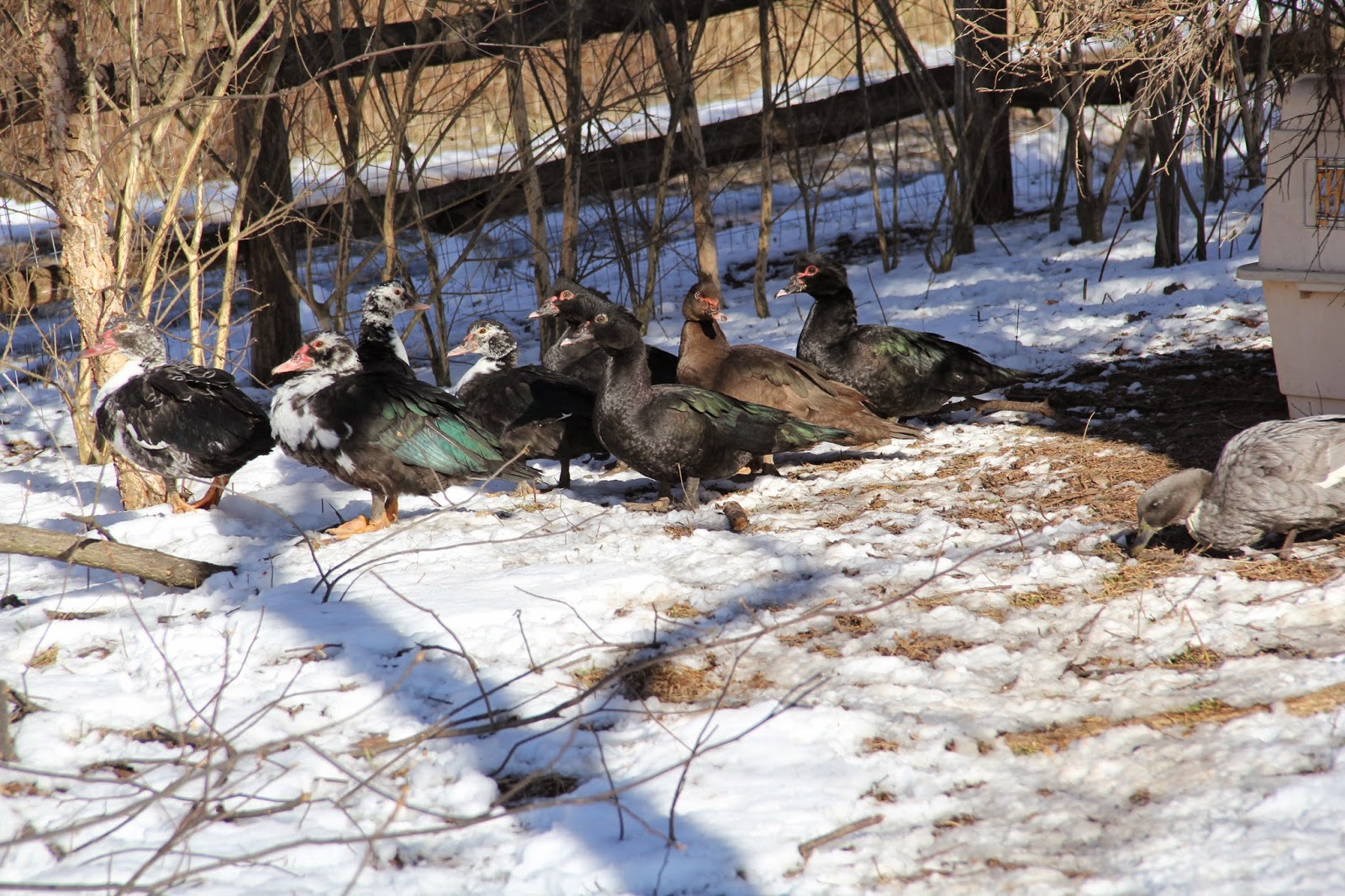
The Pato Caseros have some very interesting features involving how they mate. The males first of all unlike 97 % o other bird species have penises. These are long (8") spiral shaped penises that are usually kept inside a sack inside the drake (male duck). In a split second (1/3 of a second) the drake can shoot forth his penis, which is driven by lymph instead of blood, inside the ducks vagina in order to mate. The female duck vagina is equally elaborate and long and spirals the opposite direction, with all kinds of pockets and dead ends along it. Any male that forces himself upon a female duck ends up ejaculating into one of these pockets or dead ends. When the female duck approves of the male she relaxes her vagina and allows the drake to deposit his ejaculate further up its track. The muscovy shows this very interesting evolution of the sexual organs in response to male sexual aggression. The adaptation is so successful that only 3% of forced matings result in fertilized eggs. On a biological level this is an interesting adaptation to ensure consensual duck copulation, on a symbolic level the spiral is significant, and the fact that the male and females have opposite spiraling sexual organs is very striking.

We find these ducks to be a very important addition to our Conuco!
Saturday, January 10, 2015
Conucos, Taino solutions for Climate Change!

The Sacred Taino Earthmound, the Conuco, is an enduring Spirit who continues to bring forth its wisdom and solutions to our lives! The Conuco was the mounded gardens of our Ancestors, fertilized with Bat Guano, shells of sea creatures, rotting organic matter, and fertilized most importantly by the Spirit of the Taino Dead.
The Conuco is Ancestral Wisdom in a form that is especially important in the challenging roads that lie ahead in now adapting to the climate change that is already taking place, and which cannot be stopped. Adaptation is essential, and the Taino Conuco once again rises, as if from Coabey herself, to bring forth the fertile life giving mounds that simultaneously feed the living, honor the dead and catch and filter the erosive waters of the rains.

Water is Life! However water slides away down the hillside, eroding the hillside creating gullies like the ones shown in the cheeks of Boinayel, Cemis of the rains (shown above). This is especially true for soils that have been cleared for agriculture or horticulture, and for slopes that are steep. Erosion is exponentially worsened with impermeable surfaces, such as concrete blanket our Mother. A heavy rain takes valuable rich topsoil and deposits it into streams, who swell with the rains into raging, muddy rushing rivers. This topsoil is then taken into bays and oceans where it can negatively effect marine ecosystems. In this same way water also slips away from the gardens which soon dry out once again. With the amplification of the ferocity of rainstorms and the unpredictability of droughts, the Conuco becomes even more important.
There are many forms of Conucos that we work with today. Some are small and composed of soils, manures and mulches. Others are built up with rotting wood or branches and any other biodegradable natural substance, such as old clothes, bedding, oak pallets and so on. These are then covered with top soil which is collected in the process of flattening the hillside between Concucos to create terraces.

In this way the Conucos, which are placed on the contour of the hill are able to catch the water, and the rotting logs inside them act both as a sponge to absorb the water and as a source of fertility for the plants growing in the Conuco. These rotting logs will continue to decay releasing further fertility for years and acting as a carbon sink. The Conuco is a world of simultaneous putrefaction and regenerating growth, it is the world of the Dead and the Living in a Sacred Place. It is the Sacred Crossroads of Life and Death.

Within the decaying wood we see many organisms such as the beetle below who thrives in this decaying environment. We also know that there are many more micro-organisms, invisible to the naked eye, who contribute to this incredible process of decay and the recycle of nutrients that will once again be absorbed by life into root, stem, leaf, flower, seed and fruit. It is a world inside of a world that is vital to us as Tainos, Paleros and those who understand that our relationship to Mother Earth is Essential!

Also within the decaying wood we find fungi fruiting with its intricate arrays of white mycelium making networks throughout the wood. These are critical in the breakdown of the wood into humous. As Paleros this is another face of the Mpemba, the white chalk of the Dead!

Also within the Conuco are the multitude of ingredients that we add to attract the Spirit, to bring the blessings of the Spirits of the Waters, the Spirits of the Oceans and Floods; the elements that come from many Caminos of the Earth that bring Spiritual Strength and Resilience to the Conucos. For those who understand the essence of Fundamento, you will be able to see the expanding in understanding that allows one to define Fundamento also in terms of Conuco. The Conuco below is the same one as shown with all the logs, but is now covered with soil.

The Conucos pictured here are on the hillside adjacent to one of our Bateys and we see them as a natural extensions of the Batey, the necessary accompaniment to them. In the foreground of the photo below is an "Empress Tree" which is next to the area of the Conuco shown in the first photo which is the shrine for the Cemis and a space where we focus offerings for the Spirit. The Empress Tree is interesting in that it is not a native tree, however it flourishes as what is termed a "Weed Tree" along roadsides all over the area. This one sprung up somehow and has amazing huge tropical looking leaves in the summer which are nitrogen rich and form a wonderful mulch and soil amendment for the garden! The empress tree is a good example of adaptation and we likewise adapt to embrace the tree, just as our Ancestors would have.

In winter the Conucos are blanketed with snow and go through multiple freeze-thaw cycles that all enhance the soil. Below the Empress Tree along with a Palo Muerto (Dead standing tree) stand over the shrine of the Conuco Cemis. Yucca plants surround the Cemis, which is commonly found in Graveyards in this area. They mark and protect the sacred space.

Today we face a crossroads of Fire and Water as the Earth Changes gather momentum. Taino Ancestors built the Conucos without machinery, without metal! Here we are today seeking to bring solutions for healing for the Natural World and simultaneously for the world of all Living Beings, yet we are starting with a highly degraded and abused Earth surface. The soils have been depleted now here for hundreds of years through farming, logging, orchards, quarrying and more. Dramatic action is required and the numbers of people contributing to destruction and consumption is significantly greater that the numbers of people contributing to healing and regeneration. By using this small tractor, which is very efficient, we are creating the Conucos which will trap carbon, reduce erosion, grow a tremendous amount of plants, vegetables, fruits, raw materials, food for birds and other wildlife, as well as bring beauty and harmony to the environment, bringing happiness to the Living and the Dead! Once the Conuco is built it will continue indefinitely and our need for the tractor will greatly diminish. In our analysis it is wise to use what fossil fuel remains to make those positive and regenerative changes that can feed generations to come so that they will not need to rely on the fossil fuels.

Below the same Conuco which is all brush above is now covered with soil and will begin its process of decay!

A final view of the same Concuco from the opposite end reveals Ceremonial grounds in the distance. The Conuco will now go through the winter with all its magic occurring under its surface to break forth in greenery in the Spring! The shrub in the middle of the photo is the Elder bush, a native shrub which has become a extremely important plant for us here. It was a gift from Mother Earth herself as we did not plant any of the Elders that we have here. This fall for the first time we propagated Elders in the Conuco that has the Conuco Cemis Shrine. We look forward for the wisdom and knowledge we will gain in observing how the Conuco will enhance the Elder's growth! We see the working with the soil, the Earth herself as a great blessing and opportunity to reclaim once again our Ancestral Wisdom. We also see it as an opportunity to embrace the principle of humility as our hands get dirty and our sweat pours into the Earth. It is our way to show through ACTION our principle that the Rights of Mother Earth are Primary for all of our sustainability!

WATER IS LIFE!

Water is the Spirit that allows Life to flow in the forms and rhythms that we know it in this Physical-Spiritual Reality! This is a reality that Indigenous Peoples throughout the globe have always understood, and known, without a shadow of a doubt. Of course our lives are lived in the incredible and beautiful balance of Water, Fire, Earth and Air, to simplify the elements of life. We experience relative heat, cold, dry and wet in our lives. All life upon the Earth requires the balance of these elements, some adapting to more cold, more heat, more moist or more dry conditions. A wondrous array of spirits manifest in the desert adapting to its harsh heat and arid conditions, a similarly wondrous array of spirits manifest in the jungles, and in the temperate forests, and in the arctic tundras! However all this exists within a delicate balance inside of a small window of temperature and within the amazing and spiritual water cycle that blesses the Earth.

Life evolved from the water environments upon the Earth and our personal journey to come into this experience is through the waters of our Mother's Womb! Our Taino Ancestors (along with the multitude of Indigenous Ancestors of the Earth) understood the Sacredness of the Waters. The World of the Dead's entry is understood to be through bodies of water such as Lakes and Lagoons. Our practices involve many ceremonies with the waters. Our Ancestors of the Caribbean, in particular had intense relationships with the Sea around them (Caribbean Sea) as the Sea was as vital as the land, and they were able to find great sustenance in the Ocean. In particular the Taino fishing practices continued very much intact into modern times, as I have memories of fishing with relatives using Taino methods, including using lanterns at night to attract the fish, nets, and harpoons. At that time the Ocean was still full of abundance. This changed due to the industrialization of the islands, which has devastated the fish.
Indigenous understanding does NOT reduce Spirits, Cemis or Mpungos to "things". We understand that all natural elements and forms have Spirit! Not only do all the plants, animals and stones have Spirit, but there are even greater spiritual entities upon whom these spirits (including ourselves) rely. These are spirits of the Waters, of the Sun, of the Storm, of the Fire, of the Air and so on. Our Ancestors (and we continue today) had names for all these Spirits and did not feel the need to rank them, belittle them or dilute them. Of course based on the immediate environment of the People one Spirit might take precedence. For example in the Caribbean the Spirit of the Hurricane is very powerful, whereas in a place that does not get hurricanes this would not be so. Again for people dwelling right next to the Ocean, the Ocean becomes principle, whereas mountain Tainos would have more intense relationships with the Mountains, Rivers and Waterfalls. All this is common sense.
It is hard for those whose mind has become calcified within the modern rigidity and arrogance of classifying and ranking, dissecting and reducing everything to a periodic table of elements and the number of electrons, neutrons and protons everything has. Unfortunately this stunted way of thinking has impacted our communities, with ongoing devastating results. Sadly those who are awakening inside of their Indigenous Identity today have to turn to the internet because of lack of connection to the Earth and Elders. Here they have a great deal of ignorance and misinformation to overcome in their search for the tools to embrace that Identity.
Our Taino people in particular have a lot of obstacles to overcome with regards our Indigenous Identity, but more particularly, our Indigenous Practices. There are those misguided folks out there who are so insecure in their identity that they attempt to build an identity by shear might. Professing to authorities on everything Taino, in truth the know little about anything. Meaning, rather than truly following and seeking out the Spirits, they invent so called ceremonies that are a mishmash of other Indigenous People's traditions and christianity with a large dose of pop psychology mixed in. To truly embrace our identity we must strive to reconnect with our Ancestor's mindset regarding the Earth, the World! Modern psychological ideas are not necessarily relevant in a traditional Indigenous world view.
In our current moment in time, suffering as we are the culmination of 500 and more years of colonization, oppression and the utter devastation of our Natural Environment, we must look honestly and with courage at the path ahead of us. The cry around the Earth at this time is to protect our waters, which in turn protects our water cycle, our health, our existence! The poisoning of the soils leaches into our waters, the poisoning of our air leaches into our waters. This poisoning is being fueled by a thirst for energy via the thirst for fossil fuels that enables men to become "supermen" via the machinery that allows the illusion of domination of the earth by "supermen" to occur. This poisoning is being manifested through FIRE, out of control FIRE, that consumes and consumes and is never satiated. This manifests in our bodies in the form of disease, stress, anxiety, skin disorders, and more. The fire element is out of control because of the attempt to use it to dominate the Earth, Air, and Waters.
This out of control fire element gives rise to the highly aggressive and competitive behavior that marks every aspect of western society, and we Tainos are not just the victims of it but have in some cases become the victimizers. This competitiveness is easily seen on the internet as one individual attempts to surpass the next in what they frame as "Taino wisdom and knowledge" but what is in actuality made up fantasies, nothing more!
It is essential at this point to give some examples as a way to illustrate the distance between modern self ascribed "ceremonies and traditions" and our Ancestral Traditions. The first example is regarding ceremonies connected to Astronomical Occurrences. We know that our Taino Bateys were oriented in particular with regards Summer and Winter Solstices. For the gardener and horticulturalists it is very obvious as to why these moments are important within the cycle of the year as many plant's growth is dominated by day length as well as moisture and heat. Our Ancestors (who did not have smartphones and computers) needed to know when the days would increase and decrease in length. These moments also mark the cycle of the Sunrise- Sunset and the journey of the Sun along the horizon. There were practical reasons this knowledge was important, and our Ancestors understood and honored the Spiritual intelligence behind and within these rhythms. A solstice ceremony was not about pop psychology because you must understand that our Ancestors were living in a cleaner, healthier environment and were interrelating with that environment as a living entity. They were mentally and psychologically balanced in ways that we cannot fathom today.
Similarly ceremonies done with various animals were connected to the relationship of those animals to the people. Those ceremonies could be hunting ceremonies, or migration ceremonies which were timed and in tune with the natural migrations of birds and fish, or timed with the best season for hunting any given animal. These would be done in the appropriate environment and with the appropriate legitimate materials not caricatures. These were also fueled by the practical needs of the people. They were doing these ceremonies because they needed to eat! The Ceremony had a direct connection to its result which would be the abundance of "harvest"! These were not theatrical events, or psychological encounters, they were practical, realistic and grounded ceremonies that had visible results!
Today the reality of Earth Changes (Climate Change) is upon us. The Earth is overheated due to the out of control fires upon her. This is manifesting as increased forest fires, increased drought, more highly energized storms, tornados, hurricanes and cyclones who dump more water in shorter amounts of time leading to flooding and the erosion of soil, damaging of crops, destruction of homes and so on. As the Fire element continues to be abused, the Earth responds with greater extremes in the water cycle. All present data and future predictions as to the changes that climate change is bringing point to dramatic and devastating changes in our water cycle.
It is our heartfelt recommendation to our Taino people that we focus on what is real and inevitable rather than on fantasies, ego trips, and psychological insecurities. The greatest insecurity we face is our food, water and air, because too much fire has been burning. Some of the most important ceremonies we must be doing are the water ceremonies and those ceremonies cannot exclude the personal relationship we have with water in our lives! I encourage my Sisters and Brothers and all Relatives to seek out the Waters, give them offerings, cleanse yourself in the waters and ask the Spirit of the Waters to bring you to your senses and to bring true solutions to the critical challenges that lie ahead and that are already upon us all!
Thursday, February 13, 2014
Beneath the mask of Winter Snow, Spring is awakening!

After a winter of intense snow and cold, these later snowstorms can make us feel that winter is never going to end. In all appearances, the landscape looks barren and brown and white with the snow. As we struggle to walk through the 18" of thick heavy snow that came with the recent storm, and walk through the forest and down to one of the many springs that run through our forest, we see that although it looks like a winter landscape, spring is right below the surface. Spring is in the swelling buds on the trees, spring is in the increasingly flirtatious bird activity, and spring is in the energy rising from the earth, which is amplified within the Trees (palos) as the sap rises back up into their branches. This is the time of year when the maple sap is collected in the trees as the sweetness rises back up to be expressed in leaves, seeds and fruits!
(Note: Paleros collecting Palos should understand the different energies the tree moves through during the cycle of the year (solar cycle) and the lunar cycle. It does make a difference when we cut the Palo, especially if we are working with the subtle energies closely!)

The springs in particular reveal the beginning of a new season of growth. The snow melts into them and so they are the only place in the forest where water, earth, and rock are revealed. Within them brilliant green appears, even more vibrant because of the surrounding snow. The greens of mosses, ferns and grasses who are fed by the constant trickling water of the spring are a visual tonic to the eye, mind and spirit.
In these times of Earth Changes, it is vital that we re-establish our relationships with the natural cycle of the seasons, and are able to recognize and understand the true beginning of the seasons, and how to move in a way that is in harmony with the seasons, not relying on set calendar dates to guide us. As the Earth Changes become more extreme, and water systems, agricultural systems and ecosystems continue to become strained, we need to once again become humble to learn from the Earth herself, as our glorious Ancestors once did.

The camera often captures some of the myriad spirits who are constantly looking at us when we walk into the sacred forest, or by the sacred river. They have so much to teach us, and by truly learning the Art of Observation, which is a form of Meditation, we can open our Inner Ear to their Wisdom!

Tuesday, December 10, 2013
Caribbean Spirituality in the Snow


Although our statements here may be considered controversial by some, from our perspective being in the Diaspora adds further depth and expansion to our Traditional Caribbean Practices. This is not a dilution or weakening of the Traditions, or an "Inventos". What is a fantastical mistake is to think you can take a Tradition that arose in the Tropics and apply it blindly to a Temperate Region with no respect for or sensitivity to the Natural Mpungos of that region. That is a disrespect not only of the Mpungos but also of the many Indigenous Ancestors of this area.


The "purity" is in the Mpungo! "Purity" must be redefined, not from a colonized perspective, but from a Traditional Understanding.


Subscribe to:
Posts (Atom)