Monday, November 2, 2015

Day Of The DEAD!


DIA DE LOS MUERTOS

Signs and symbols of decay and death are all around us at this pivotal time of the year, here in the temperate regions.  Trees drop their leaves, plants die back to their roots, seeds are scattering and plants are drying up, either shifting into their dormancy phase or completely dying, only to return through one of their seeds sprouting next spring.  The intense shades of green are slowly shifting through a rainbow of colors to the various shades of brown that surround us in the depth of winter.  

It is a natural time of year to honor the Ancestors.  Not only do the natural signs remind us of the reality of cyclical death, but also the harvest culminates at this time in the form of those plants that will store through the winter and provide for us during the cold and apparently barren months.  As the life force of the plants around us recede to their roots, the internal life force of the living is more easily perceived, and the Ancestors step closer to be honored and for profound communication.

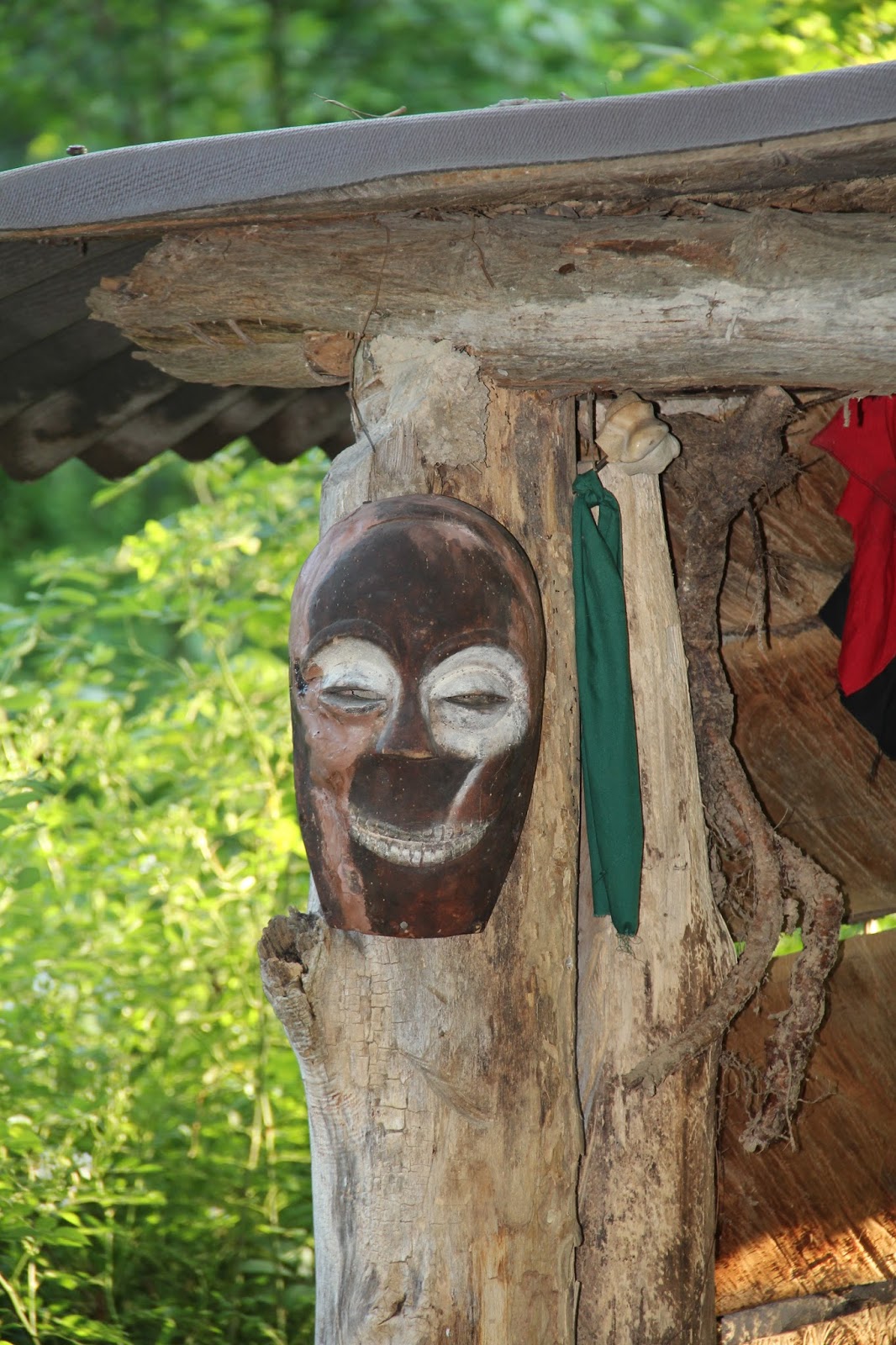
Every year our Ancestral Honoring ceremony, which occurs variously any time between the very end of October and beginning of November, is very different.  Sometimes it is inside one of our Munansos or Bohios, sometimes it is outside.  Sometimes it is under a tree, sometimes it is in a wide open Batey.  Here we share images from our Day of the Dead / Ancestral Honoring Ceremony this year (2015).

Preparations for the Day of the Dead begin weeks in advance, as the space is cleared.  The very process of cleaning and preparing the space is a vital part of the Ceremony, and brings blessings and teachings.  We begin here with a Batey that is between two of our Conucos.  The conucos are both covered with various weeds, including magical plants such as Datura, Poke weed, Amaranth and grasses.  Cleaning the Conuco allows us to look at what the plants are telling us about the condition and fertility level of the soil of the Conuco, guiding us to important decisions about how to care for the Conuco over the winter, and what to plant in them next spring.   We pull up deep tap roots from the Poke Weed and the extensive gripping root system of the Datura.  The upper Conuco also hides potatoes within it and further along, many perennial flowers.  Before any action is taken in the clearing process, various herbs and resins are burnt, pulling the Ancestral spirits and Natural spirits closer, alerting them that we are preparing space for ceremony.  A staff is placed in the Earth, along with medicine, machete and hoes are also placed centrally, as the cleaning of the space is ritual and not mundane in nature. 


With the machete all the large plants are cut to the root, and then using the hoes the roots are removed from the Conucos, symbolically removing debris, clearing away the old, recycling the dying, drying plants.  It is a large Batey and this process takes days.    The burning of resins and herbs continues.  The plants that are cut down represent the sacrifice that removes obstacles, that clears pathways, that opens roads.  Our sweat is also the sacrifice as it falls to the Earth, it is the testament of the Actions that lead to progression and positive growth.  It is uplifting to see the space cleared and feel the spiritual energy building.  
As the space is cleared, the Ancestral focal points is cleared and built.  This year it is in front of an Elderberry shrub, a very important plant for us here.  Where the Ancestral offerings will be placed is a Cemis under the Earth, or in other words a Bilongo under the Earth.  The details are not shared here.  It is a space that has been spiritually worked already.  As we clear it, the energy quickly builds, becoming palpable.  


The hoes and other tools that we use to clear the Conucos have been spiritually consecrated, since these are tools that we use for our Sacred Conucos.  Our Taino Ancestors used the Koa (Digging Stick).  Although we have a digging stick present (it can be seen with a gourd on it, we are very grateful to also have metal hoes,  machetes, files to sharpen them, as the work involved in clearing the space is intense.


Slowly various Ancestral Staffs, and Nkisi and Cemi are brought to the Ancestral Focal Point and placed firmly in the Earth. The burning of resins and herbs continues, especially tobacco and sage that we have grown.


The preparation of the space continues over weeks, and all the staffs, Nkisi, Cemis are given fresh adornment using not only cottons and raffia but also decorations from the many plants growing all around.


In front of Guatauba Maquetaurie (Lord of the Dead), the many food offerings are placed.  These include many things grown here, such as the corn, gourds, grapes, peppers, as well as apples, various drinks, and more.  
There is a total of nine staffs representing the many Ancestors, known and unknown.  We always acknowledge all those Ancestors who lived on this land before us, including Indigenous, African and European.  We acknowledge those Ancestors in the Cemetery right on our driveway. We remember our neighbor who passed a couple years ago.  The Ancestral Honoring Ceremony is about ALL the Ancestors, not just direct biological ancestors.  


Among the offerings is Elderberry wine that we made from last years harvest of Elderberries.  We are very grateful to be able to give the Ancestors wine that we made from the land here.  Also present is rum which has been soaking with the jalapeƱo peppers that we have grown.  Of course coffee, cigars, candles and water is also offered.  The corn from the Conuco is a rainbow that we are also so happy to be able to offer the Ancestors.  We include a bouquet of flowers picked from the gardens, including horsetail, rattlesnake master, aconite, agastache and lavender and of course echinacea.

This year our daughter baked a chocolate cake to be presented.  It was spiced with cayenne pepper and cinnamon and adorned with cayenne peppers that we grew this year and dried.  She was delighted to be given this important responsibility.
Central to our yearly Ancestral offering is the traditional roasted pig head presented with various root vegetables (yucca, jautia, batata, name) and green bananas topped with bacalao and red onion and saturated with olive oil.  Many cigars are placed all over the food for the many Ancestors who are attracted to our offering.  All the cigars have been brought by those whom the Munanso has helped.
Honey is also an important element of attraction that we include in this offering.  Two cigars from the jungle, brought by a Yayi of the Munanso in gratitude, are placed with honey for communication.  The aromas of the hot food, tobacco and sage and sweet grass (all grown here) and the many resins, fill the air as we each make invocations to the Ancestors.  

The various images of the Ancestral Staffs, Cemis and Nkisi evoke the many and various expressions of the Ancestors.  Every year it is different, yet every year we are blessed with the abundance.


Wednesday, October 14, 2015

Sunday, September 6, 2015

The Yayi's World -By the Yayi Nkisi of the Muanso

Over the years I have heard more than one Yayi complain to me about Palo Mayombe Tradition being 'patriarchal' and centered more on the Tata's role than the Yayi's role.  From my own experience, while I understand the complaint, I could not disagree more, when it comes to the Munanso here.  

We always have to take into account, not only the impact of colonialism and slavery on the growth of theTradition, but also the structure of (white) male supremacy that we are compelled to live with.  However, at their root and in their heart, our various Earth Centered Traditions are deeply rooted in the Mother, and her role of giving, and taking life.  This is not to say that there is both a lot of male centered rhetoric concerning the role of Yayi out there, and perhaps a domination of the internet by Tatas rather than Yayis.  At every turn in my trail, my Camino within Palo Mayombe, I have been strengthened and encouraged as a Yayi to take active and indeed leading roles within the Munanso.  For those Tatas that insist on Yayis having nonsignificant roles in the Munanso, my guess is that they are fundamentally threatened by the powers of the Yayi because they are infected by the mental incarceration of white male supremacy.  

Before I became a Mother, I was a Yayi, and both of those Initiations and Tratados strengthened the other.  As a Mother, giving birth, I realized that the process of giving birth is a process of walking to the world of the Dead and bringing Life from the Dead into this world.  Giving birth is a moment of standing on the Kalunga line, much like those moments in the Munanso when we draw the patipemba (firma) on the Earth and invoke the Dead to this Living Moment.  

There are many out there who complain about animal sacrifice, most of whom are also carnivores and have no problem eating inhumanely raised battery farmed chickens, hogs and cows, which are slaughtered in the most vicious and heartless of manners.  It is never easy or gratifying to take a life, even when it is to sustain ones own, however it is the way of this world.   It takes more responsibility, more consciousness and requires more humility to take the life of an animal that you raised yourself than leave the "dirty work" to some one else.  It is only in this modern day that such a large portion of the Human Family have become so disconnected from the life that sustains them.  

Here, we are going to go on a journey into a specific process that we recently did in order to address some intense spiritual energies, and to fortify, vitalize and strengthen the Nkisi and Ancestors of my Munanso.  The 4 chickens that we used were 4 older chickens from our hen house.  These chickens had been with us for years, arriving as day old chicks.  Besides being entertainment for the family, they ate kitchen scraps and laid eggs for our table to be enjoyed by ourselves, our friends and relatives.  In fact our youngest child's first solid food was egg yolk from these chickens.  This year we got more chicks, and so the decision was to cull these older birds (which is typical).  They are far to tough to roast (for our spoilt modern tastes) but would make good stock, however, we are Paleros and have another use, which to us is a very honorable way to "cull" the chickens.  

These chickens were specifically used for the Nkisi of my Munanso, for the Nguenges.  When working with my Nkisi, I do everything, other than use the Mbele.  

The aspect that I want to share here, is the gutting and cooking of these chickens.  Inside the chicken I found not just mature eggs, but lines of eggs getting smaller and smaller, numbering in the hundreds.  It was an awe inspiring sight and for those with Vititti, numerous spirit faces and figures can be seen.

 Here the mature egg is covered in a sack, much like a placenta.
 Behind the mature egg, eggs yet to be born line up getting smaller and smaller and paler as they go back.  
The mature egg was removed to be given directly to the Nguenges (witches) in their tree with a particular message.
Here you can see the numerous immature eggs, almost like a reverse Ancestral Tree, stretching back or forward in time....
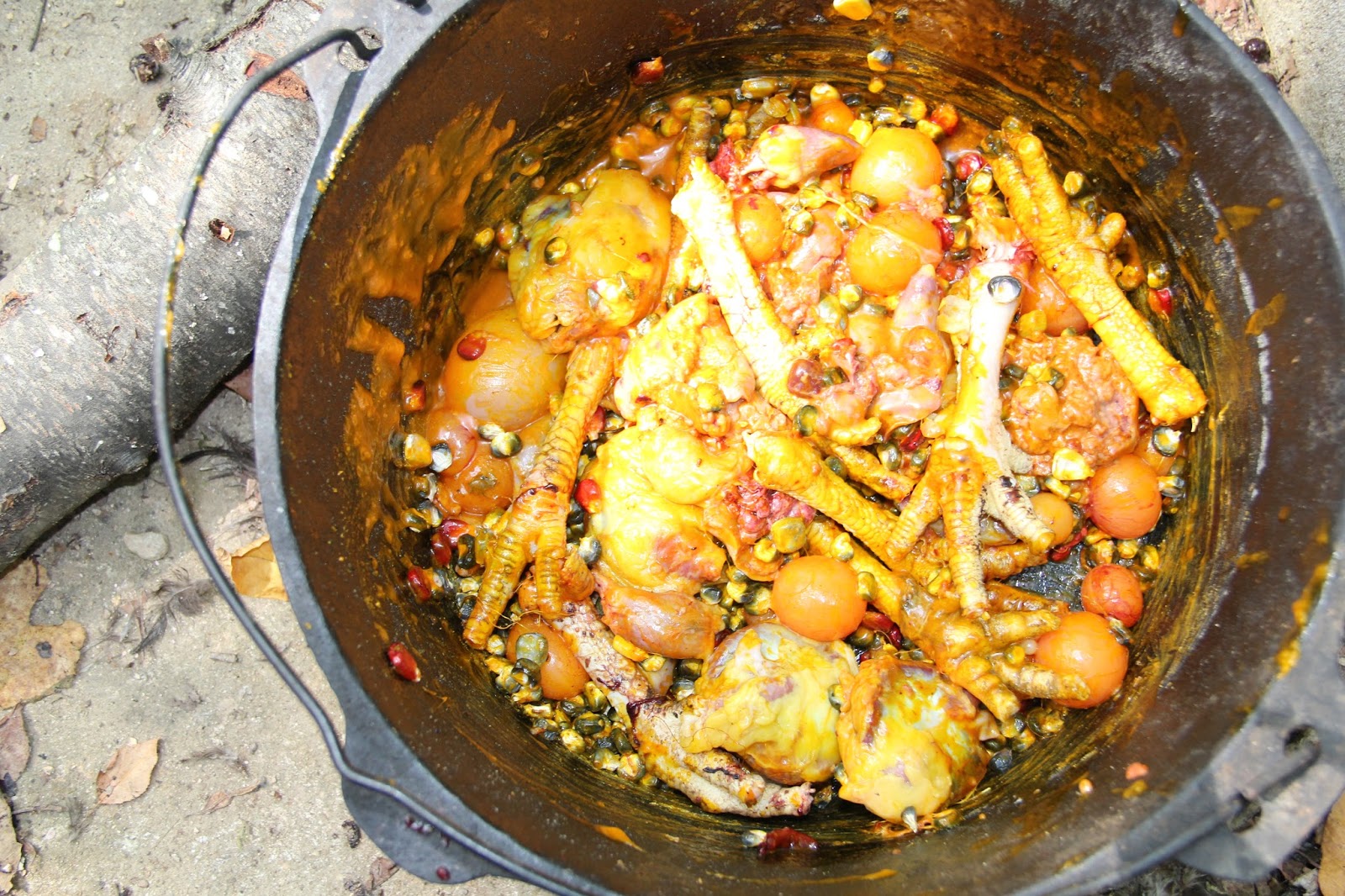
The organ meats are cooked in the iron pot, and those immature eggs are included.  The energy in them is potent, and can clearly be felt.  Here you can see the line up of the eggs from mature getting smaller and smaller.  These powerful embodiments of fertility will bring great energy to the Nkisi and Ancestors.  They also remind us of the Sacredness of Life, and the importance not to make sacrifice in vain, the importance of taking responsibility for ones actions.
Here the organ meats, feet and eggs are all ready, each holding vital energies that are essential for the continuation of life.  
Corn from our Conuco is added, along with palm oil and the food is ready to be cooked.
Three mature eggs (just like eggs you could buy from a farmers market or store) are ready for their journey to the Nguenges Tree.
Chickens and Organs are cooked on the open grill, and I take some moments and burn some sage and tobacco to acknowledge the sacrifice of the Trees that provide the wood and the many small insects that call this wood "home".  
The aroma of the chickens cooked in palm oil fills the air, combined with the aroma of the tree wood and fire.  When the food is ready it is taken to my Munanso to be presented to the Nkisi.
This resident spider hangs from the rafter above the Nkisis.
Inside my Munanso, the chickens, along with Coffee, Melafo, Nsunga, and Champagne are offered to the Nkisi.  The various herbs around the Nkisi are very important in the Munanso, and much of the time, herbs hang from the rafters to be used for various purposes.  
Another closer view of the chickens.  
 I take the guts along with the three mature eggs, carrying the message to an amazing tree we are blessed to live with.  This is the tree of the Nguenges and many important offerings are brought to her.  She is half alive, half dead, and her entrance is a powerful view into a subterranean world where the vibration of the Dead can clearly be felt.  
 The tree is an inspiring sight, a giant within the Nfinda, magical forest, overlooking a sacred spring, surrounded by the herb "touch me not" (jewel weed).
Fertility is everything to life, for without it nothing grows.  Even the most powerful seed cannot express itself without the rich moist earth providing it with fertility.  No endeavor can come to fruition without the creative energies of fertility, and of course no Ancestor can incarnate into this world without fertility.  Without fertility we cannot grow food.

Fertility is being ripped from this Sacred Earth as trees are cut, soils are eroding, and the sacred water cycles are interrupted and distorted.  Quiet as it is kept, many conflicts around the world are caused by loss of the Earth's fertility, and are solved by restoring the Earth's fertility.  The Yayi holds a critical role in the world of the Palero because she is the embodiment of the energies of fertility.  She is the embodiment of the energies of the water cycle.  These powers bring life and they take life.  Having a healthy relationship to these powers is essential within any Tradition which is focused on a sustained and harmonious existence.  For Paleros, Water, Soil, Air, Fire, are not "things", these are living entities, powers, Mpungus, which extend their reach in this world and into the world of the Ancestors.  

Saturday, September 5, 2015

A simple Munanso Moment


Here we show a glimpse of one of our techniques to refreshen the Nkisis after some heavy work.  We utilize plants from our Conucos, and burn some of the Tobacco that we have grown to uplift and vitalize the Spirits.