Wednesday, June 20, 2012

Ceremonial Tree

Trato son Trato

There are agreements with the Living and there are Agreements with the Dead and there is the skillful use of Nkisi by the Brujo to navigate through difficult waters.  


The tree that is photographed here has a long story, and it is a story of agreements, Nkisi, and the wisdom of the Ancestors guiding the Brujo.  This tree was originally planted in a different location, where the Munanso was at the time, before this Land came about.  It was also originally a different tree.   
The original tree was planted Ceremonially with a large fundameto which was in the process of being created, underneath it.  The ceremonial purpose of the tree was to hold the winds of challenge and navigate the Munanso through the difficulties involved in transitioning from a state of "landlessness" to a state of "Land".  At the time there was additionally a great state of confusion created by those people and those spirits who did not want to see this transition occur due to their own mediocrity, jealousy, greed and even hatred.  


The day after the tree was planted Ceremonially, with the Nkisi underneath it, thousands of flies crowded around it, and the tree became infested with parasites and within a month it was dead as it took the spiritual impact of all the negativity and opposition to the transition we were bringing forth.   At this point we removed the dead tree, gave it to the sacred fire, and planted the tree you now see in these photos in the same place, right above the Nkisi.  This tree flourished since the original tree had absorbed all the vicious negativity and spiritual attacks that had been projected towards the Munanso.  
Once we were able to transition from "landlessness" to Land about a year later, we brought both the tree and a large marble stone that also came from the original location.  We removed the Nkisi from beneath the tree and the Nkisi continued its transformations to take on the form that it holds today.  The tree was again planted ceremonially to take up its rightful place within the Bateys of the Land.
Here the tree maintains it's thriving good health, and is quickly maturing, never showing any signs of the parasites that destroyed the original tree.  
We share this story to share a vital understanding that we hold within our Munanso, which is to always continue to develop one's spiritual practices beyond the confines or prejudices of the dominant "society".  This tree is a story of overcoming negativity, of victory within a spiritual battle.  This tree is also symbolic of the positive outcome of the Brujo listening to the Ancestral Spirit and not stubbornly walking with "blinders" on, being afraid to develop the spirituality further.


One thing that we know is that our Ancestors were constantly evolving and transforming the ways that they communicated with the Dead.  For example if we look at the spirituality of the Arawak peoples as the spirituality changed and evolved we see all through the chain of islands that is the Caribbean the diversity of spiritual practice, which all followed some central principles, yet was very different in its expressions.  Spirituality is an expression of the Essence of Ones Spirit inside of this Mother Earth that we find ourselves within the Community of the Living and the Dead.  By Living we also include all Living forms, and even include the minerals and metals of Mother Earth.  Spirituality is not a stagnation and it is not a dogma.  


Many Paleros like to utilize the term "Religion" to describe Palo, however that is a term that we personally find to represent a more dogmatic, stagnated form of spirituality, usually guided by a "definitive word of god" text, which is constantly quoted.  Palo in our definition of it, is not a "religion" it is a "Spiritual Tradition" and like all "Spiritual Traditions" or "Indigenous Spiritualities" upon the Earth is always undergoing transformations, yet holding onto Spiritual Principles of Thriving and Evolution and continuing discovery and understanding of Mother Earth and all her Life Forms (Spirits or Relatives).  


We are well aware that many folks will criticize our practices and claim that there is no precedent for this particular ceremony with the trees and Nkisi, and we can dispute that on various levels, including historical ones, as we all have to agree that Palo developed in the Caribbean undergoing many transformations, and it is only ignorance that today would have Palo suddenly become stagnant and rigid.  However, one of the most compelling "arguments" for this particular ceremony is that "it worked".  The original tree with Nkisi underneath did indeed take the impact of all the negativity and indeed "brujeria" and the second tree has been able to flourish.  We put many Palos in the Fundamento, however in this case we utilized a "living palo" to enable the Fundamento to overcome the obstacles and opposition.


Saturday, June 16, 2012

Plant Spirit (A rare glimpse)

(Click on photos to enlarge)

During the bright light of day, it is rare that we can truly "see" the Spirit of the Plant express itself within the very shape of the plant.  However there are times of the day- night cycle, and times during certain weather conditions when the Spirit reveals itself much more clearly.  One time of the day-night cycle we use a lot to see the Plant Spirit is dusk, when the Sun has set, or very early in the morning before the Sun rises, or at night, especially with a full moon.  However it is very difficult to take photographs that accurately represent what we are seeing during these times with the camera we have.  So we look for certain Weather conditions to take photographs to "capture" glimpses of the plant's Spirits!
As Paleros and as Tainos it is vital for us to build a relationship with the various plant Spirits that we utilize in our Spiritual Practices.  There is a world of difference between going to a Botanica to purchase so called "fresh" leaves or dried herbs to make a Spiritual Bath, or going into our gardens, parks, forests and streams to find and directly interrelate to the whole plant or tree that gives us those leaves.  Relying on the Botanica separates us from the source of the plants and we miss out on this direct experience, although we are well aware that many of us do not have the access to the plants directly due to location or mobility. We are fortunate to be able to be in a place to study these things in depths with direct access to the plants under all kinds of weather conditions and at all times of the cycle of day-night and the yearly cycle.  We are able to see the plant grow from seed to seedling, to flowering plant, fruiting plant, to seed producing plant and also see its death and return to the Earth's soil.
This plant here is a Rhubarb plant that has large heart shaped leaves.  Its stem is edible (delicious) but its leaves and roots are "toxic" although the root is a powerful medicine if used by a fully qualified herbalist.  During the heavy rain storm the leaves become fountains or funnels.  For those who have followed the various research concerning vibrations of water and how water absorbs the vibration of whatever is around it, you will realize here that if we were to collect the water that is flowing off this leaf, we would have a very special water that could be used for certain things Spiritually.  (We do not recommend drinking this water).  
When we look closely at these photos, we can begin to see the multiple Spirits that are showing us their faces within the surface of the leaf, as revealed by the water flowing over it.  Some are old, some are young, some are almost like petroglyphs, others are more like animal faces, or faces that are not human, not animal, but clearly intelligent.  It is at this point that we can begin to appreciate the multi-dimensionality of the plant that we may be using to create an important Spiritual Bath, or to utilize directly in the Fundamento or Nkisi.   We can also gain a greater appreciation for the Spirit within the various plants that we may need to go to the Botanica to pick up.  
When we take the time to study these things, and take the time to be outside with the plants under various conditions, and we take the time to go walking in the forest, or up the mountain or by the river, we are stimulating our Minds and Spirits to bring us further wisdom an understanding concerning the Plants that we use Spiritually, as well as the soils, Palos, stones and so on.  We also come to understand that depending on where the plants and trees are growing, they will have a healthier or unhealthier vibration which also will have an impact on how we may use them or decide not to use them.  This rhubarb is in a very diverse and lush garden which is not sprayed with any chemicals whatsoever.  This rhubarb has a very different energy than a rhubarb that is grown for profit in a monoculture.   Just as these have different levels of nutrients if we are to eat them, they also have different levels of spiritual "nutrients" when we use them.  As Paleros, Paleras, and Tainos, these are vital considerations when we are going to use plants, as our work is about healing, therefore just a when a person who is physically sick needs high quality organic fresh food, a person who is spiritually sick needs high quality organic fresh plants for their Spirit!
We want to conclude with a true story:  One day there was a conversation going on between a few people.  One was a brujo who possessed various spiritual plants such as "chacruna" and "yage", which they had growing.  The others were several women who had journeyed at great expense to south America to have experiences with the Shamans using exactly these plants.  The Brujo pointed to the Chacruna and Yage and asked the women if they knew what the plants were.  One women made a guess that they were "Peyote", which the Brujo thought was very funny as it is fairly common knowledge that Peyote is a cactus.  None of the other women could tell the brujo what the plants were, however they talked over and over again about their experiences in the South with the "Ayahuasca", never even realizing that they were sitting in front of the very Plants themselves.  This is the level of ignorance that can be found today, where we have situations that allow people to have experience with the Sacred Plants yet not even be able to recognize them when they are sitting in front of them.  


This story is not to denigrate anyone because how many of us realistically can recognize all the plants we use if we found them growing in the forest?  It is a wake up call for us to reclaim our medicinal power!

Tuesday, June 5, 2012

Masu!


While planting some new medicinal herbs and plants, the turning of the soil revealed a beautiful female spider (Masu) carrying her eggs.  We were even able to see the cord that she uses to carry them around.  (enlarge the photos by clicking on them to fully appreciate her beauty).  In the close up below you can even see her black eyes and red mouth, an awesome sight!
As Nganduleros, it is a blessing to encounter Masu when planting in the garden.  This is a powerful totem and is also something that from time to time we utilize in working with the Muertos.  This particular spider was obviously female, it is not always so obvious!
Spider is the weaver of webs, webs that can bring knowledge and webs that can entangle!

Kudilonga

(enlarge the photos)


Monday, May 14, 2012

Inriri Marks a Tree

Early one morning, hearing the usual tapping of the woodpeckers, we heard one tapping that was much closer than usual.  Moving closer to the source of the tapping, we saw a woodpecker pecking on a cherry tree with focused intensity.
He was so absorbed in his work that he did not worry about us moving closer and closer to take his picture.  As he pecked he threw out slivers of wood.
The vibration of his pecking was very strong, and seeing this we realized how strong his head and beak must be to withstand such force.
There is a Taino Myth, which we will not go into detail about right here, however it concerns the Inriri (woodpecker) and the making of Cemis.  Knowing this significance, we made note of the tree the woodpecker was focusing on.
This WILL be a tree that we will transform into a Cemis specifically the area which the Inriri has been working on.  We also gather the wood shards the woodpecker has thrown to utilize in Cemis and Bilongos and Fundamento as appropriate.
We can always take a section of tree, and with various tools make it into any shape we want, however when an animal or bird does the shaping for us, we are now working with the Spirit of that Animal and the Spirit of the particular Tree, which brings another dynamic and additional energies into what we are working with.  Just as when we use a piece of wood from the Ocean or River, we are using a Spirit of the Tree but also a tree that has been shaped by the Spirit of the Ocean or River, which brings additional energies to that wood.  
The Inriri is a bird that has a very powerful head and whose pecking sounds like a drum, and a communication.  This woodpecker has a red cap, further emphasizing the Head, the Consciousness, the Mind.  The woodpecker is digging deep into the tree for the insects that will nourish it, and throwing out that which is inedible, showing discernment and the ability to dig in deep.
All these qualities are significant, and we were excited to see this tree being marked by the woodpecker. The fact that the woodpecker was not afraid of us, and made his presence known insistently to the point that we decided to investigate where he was, all point to this being a tree that needs to be transformed into Medicine, Nkisis, Palo, Cemis etc.   
These photos show the speed and power of the woodpecker's movement.  Be sure to click on the photos to enlarge to be able to appreciate more fully the striking markings of the woodpecker!  At a later time we will be elaborating further on the Taino Myth involving Inriri and the significance of the Myth and the resulting Cemis.

Sunday, May 6, 2012

The Sacred Forest of the Palero

Before the onslaught of deprived European barbarism, this continent and especially the region we live in was covered with Mother Earth's favorite garment, forest.  Now we see acre after acre of depleted farmland, suburbia, industrial developments and the like, including manicured lawns, spiritless "landscaping", and the repeated use of a small number of select species of trees and plants.


A palero who is looking for something more than what is offered in the Botanica may venture into the parkland or forest land to search out palos for use to make powders or to utilize for the Fundamentos or various other purposes.  However we always need to seek out the story and know what trees are imports, what trees are native, and the progression of trees that make up Mother Earth's forests.  When we see  forest land cleared and then "abandoned" we see an amazing progression of plants and trees who move in to rehabilitate the cleared earth.  What we may, in our ignorance, view as "weeds" are the first "emergency medicine" of Mother Earth.  Then there comes a series of trees, eventually giving way to the old growth forests full of Oaks, Hickories and others.  


When we trace the wisdom of the Palero in the Caribbean we have to acknowledge the Indigenous Face of that Wisdom.  It should be obvious (but it is not obvious to many) that the trees growing in Bantu lands were different from the trees growing in the Caribbean or Turtle Island (including South, Central and the North- what is misnomered "America").  The Bantu and other Africans coming in conditions of oppression (chains) relied upon the wisdom of the Indigenous People who had been care taking the forests and land for thousands of years.   We may intellectually "know" the properties of a certain "palo" or tree, however this is very different from having "hands on experience" and directly working with the Palo.  


Every species of tree and plant is unique, some grow easily under adverse conditions, some grow rapidly, some slowly, some transplant very easily, some do not tolerate transplanting at all.  Some leaf out early in the Spring, some very late.  Some have flamboyant flowers, some miniscule flowers that go virtually unnoticed.  Some are edible, most are medicinal, and some are poisonous and some are medicinal and poisonous!  Knowing the difference is essential!!!  The difference is the difference between success and failure.


When we became caretakers (also known as "land owners" in this society that operates under the assumption that land can be "owned), we became the caretakers of approximately 30 acres, and fortunately about 60% was fairly established forest, 40% was either new growth forest or hay field.  As the years have passed we have planted many trees.  Some have been planted and worked with as ceremonial trees and also trees belonging to specific Ancestors.  Others have been trees planted for the benefit of the land. We have planted and transplanted many Native Trees and have embarked upon a reforestation of most of the Land of which we are caretakers.  In the process of this, we have had the opportunity to have much "hands on" experience with these trees, and we have gotten to know them from a different perspective.
Here is our most recent "tree nursery", we get "bare root" trees and put them in a nursery to grow for a couple years before we transplant them to other areas of the Land.  This tree nursery has "honey locust", "Redbud", Maples, Paw Paw, Walnut, and Lobolly and White Pines.  All of these are Native Trees to this area, and all have medicinal properties and spiritual properties, some are edible.  All benefit the fertility of the Soil.  They all leaf out at different times, some transplant easily (root lightly) some root deeply.  They will soon become large enough to give us Palos which we can use in multiple ways.  
In the back ground you can see the Pigeon houses, which are for a specific family Ancestor (egun).  
This particular area was previously used as a hay field, and the hayfield was managed using tractors and chemicals.  Tractors do a lot of damage to the soil structure and chemicals are poison.  We began working in this area very early on, and planted a series of different gardens using a spiral form, at one point we had an abundance of tomatoes here!  The story of this particular area is interesting.  We began by plowing it using a horse with a simple plow.  The horse was an elderly work horse who with great strength and willingness pulled the plow in the spiral.  We did not want to continue to oppress this Ntoto (earth) with machinery.  Then we planted various crops and finally we transformed it into a tree nursery.
Here we are growing evergreens, both Lobolly pines and White pines (both native to this area).  These will be used as a protection against the wind and a screen at certain points on the land that are more exposed.  Pines are also important Palos and spiritual baths that we use.  We will also, in the future get some non-native Pinon species of evergreen that will provide us with "Pine nuts" to eat (Pesto or Mole anyone?).  While we use many native species, we are not dogmatic in our approach, also embracing non-native species that bring important qualities or foods to us- just like Palo in the so called "new world": which embraced both African and Indigenous Practices because the need was both survival and thriving.
We are a far cry away from obsessively manicured lawns and heavily mulched beds of single species in corporate landscaping and farming.  Our land is an abundant expression of life force, embracing so called "weeds" alongside more cultivated species.   It is just like the Palo that we know that blows in the four directions.  Rigidity does not exist in how we play our Palo!!!!  

Here a corkscrew Willow has taken root.  This was from a bouquet of willow that we purchased and which rooted in the water.  We planted it and it thrived.  It has amazing twisted limbs that will one day give us important palos!  We can also propagate many more willows from this one.  Willows have a very strong life force, you can take one branch and put it in water and it will send out roots and become a whole new tree. This is a power of regeneration which is important for us to harness within the Munanso.  Trato son trato.
Our six year old daughter's garden was one of the first to be "born" upon this Land seven years ago when she was in her embryonic stage!  Her mother dug the compacted soil, planted plants, applied natural ingredients to the soil, made mambos and so on in the garden as she created it.  Now this garden is an abundance of herbs, blossoms, medicinals, and a modern day "wishing well", which is used from the perspective of Paleros.  Our daughter immediately took to the garden and knows practically every plant in the garden and what it is good for.  She followed the trato that was done when she was still in the uterus.  
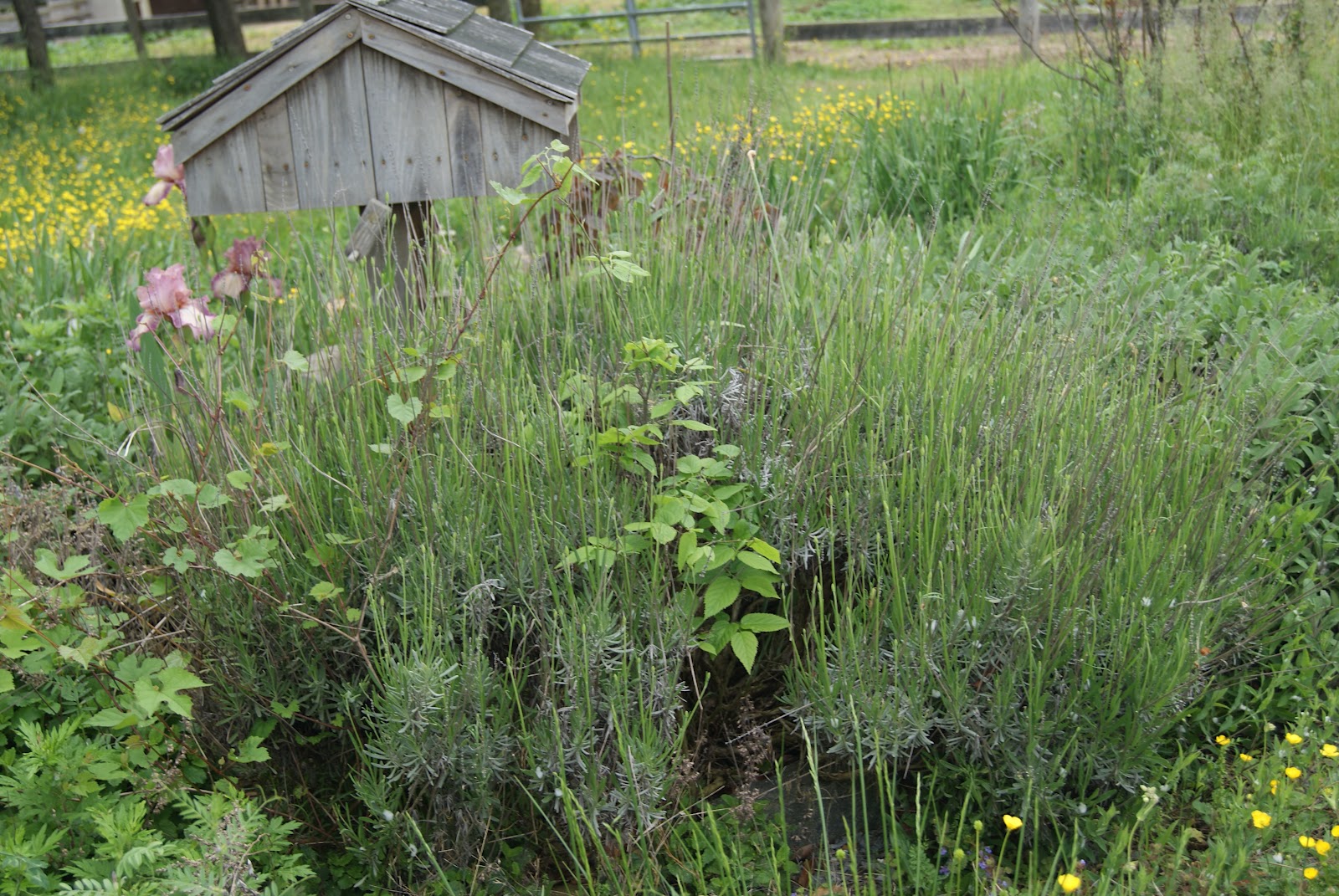
There is oregano, lemon balm, lavender, sage, a weeping beach, irises, thyme, mint, perennial vegetables, and a variety of what people call "weeds" but are really medicinal plants and plants used in spiritual baths and spiritual work!  
Here is a close up of the weeping beech, which is a non-native but very mysterious tree!  
In the garden we also find a "volunteer" tree which seeded itself, most likely with the help of a bird.  It will someday become an important Cemis or part of an Nkisi or what have you which will be for this child.  We need to remember that trato son trato and the Spirit speaks for itself, if we are able to listen.  The approach to "Earth" in this "american" society tends towards a very limited, fearful approach, whereby "weeds" are feared, almost hated, and everything needs to be in a straight line or at least grouping to be acceptable.  In the Palo we play, if the Muerto takes you, you better pay attention.  Mother Earth has a more important voice in the landscape than we do, and we need to embrace her wisdom in the same way the Bantu embraced the wisdom of the Taino- Arawak.
Over time our little hedgerow has grown.  This is very magical for a number of reasons.  One reason is that most of the plants in this hedgerow have been ones destined for "the dump", ones that various people have wanted to "throw away" in the never ending pursuit of "fads".  We have gotten forsythia, azaleas, fothergilla, lilacs, flowering pears, elderberries, and so much more.  We take what some view as "valueless" and make a value from it.  We as Paleros, see the riches in it!  Many people chase "riches" but do not know how to work with Mother Earth who is the true owner of all riches and the master of creating riches and abundance.  While Palo as practiced today is predominately so called "patriarchal", the source of all riches is our Mother Earth (Ntoto).  For example the willow above can be propagated to make a thousand new willow trees from one, each carrying the powerful essence and spirit of the original willow!  What power of abundance and amplification of power!  The Palo that the Ancestors of the Past knew was the Palo of Common Sense!  If you are playing Palo inside of Palo, then the Palo and Egun will take you to understanding and wisdom even in the absence of your physical elder, because facts are facts and many of our elders who initiated us are no longer around or have deeply betrayed us and betrayed the essence of Palo and not only this but have also betrayed the Root of Tradition which is always Nsambi.  
Again, our daughters garden has many plants that have been pulled out of places where they became unwanted.  There is so much waste in this society that it has become a way of life for many to just be consumers and not cultivators or creators.  Whatever is the fad of the moment becomes the next days "trash".  We are blessed to have a large space to caretake and we have a place for almost any plant, and we take the blessings that others waste and plant them, and they bring us abundance which is not only physical in nature.  
The photos above and below both show sage plants, one is culinary the other is a purple sage plant.  Many of us use sage in our spiritual practices, however many of us also are not aware of the amazing variety of sages that are growing on this planet.  Varieties of sage grow practically everywhere, in fact we were gifted sage from Alaska not too long ago, that has a beautiful scent.  Desert sage is very different than white sage, very different from all the other sages.    We use sage not only in the Munanso, but also in the kitchen and also to make teas for the purification lodges that we do.
Paleros always speak about the muertos, and speaking to the "Dead", but we need to never negate the fact that the muerto is skeleton but we ourselves as the physical body cannot move without the skeleton that lives within!  In understanding the skeletal structure of our own body, we begin to understand the skeletons the Palero works with.    Within our physical skeletal structure various muertos are residing, our leg bones contain different energies than our cranium or metacarsals (finger bones).  We could even say they contain different muertos.  We need to acknowledge that we have all our ancestors residing within, however different spiritual energies are amplified in specific bones.  We know that the leg bones (tibia) are especially important for certain functions that have to do with activity, because of course we move because of our leg bones, that is what propels us  one way or another way, to run, walk, jump, hop and so on.  Then we have the various bones of the spine which lead to the center of consciousness within the Kiumba our skull.  We come to realize that each bone within our body holds a unique emanation of consciousness or a unique Ancestor if we want to think of it in that way.  We could even expand to realize that each bone within our body resonates with a specific Mpungo or Power within this Universe. So to understand the Nkisis, we must also understand ourselves as an Nkisi, a walking, fleshy, Nkisi.
In understanding this, we can see above Nkisi collecting flowers for Nkisi, Muerto collecting flowers for Muerto!  Living flowers are cut to offer the Dead, however even though they "die" at the moment of severing from the plant, the unfurled blossoms continue to unfurl and reveal their beauty, and the willow will even send roots out allowing us to realize that it never actually died!  You cannot understand the "Dead" without understanding that you are the Dead in the garments of what appears to be life!    Remember as Paleros we understand that the whole Universe is a Spiritual Entity, and that the Mother Earth is just a grain within that Totality, suspended in the air just like many universes and planets that extend to infinity!
Lemon balm and a bird bath.  Lemon balm is a medicinal, is an edible, and is a very prolific plant.  Once it is planted, just like the spiritual plant Altamisa, it is impossible to remove!  Below you can see Altamisa with Thyme which is also a powerful medicinal and culinary plant!
Below there is a large patch of altamisa, which we actually picked up as a single stem from NYC, because altamisa is a herb that will literally grow up through the sidewalk!  It is a fragrant "weed" with great spiritual powers.  We allow it to spread within reason!  You may be able to go into a Botanica to get altamisa however you will not understand its tenacity, its survival instinct and its adaptability. You see it surrounded by buttercups (yellow flowers) which are poisonous and are selectively avoided by the horses who instinctively know it is poisonous.  We as Paleros of the modern day have to reclaim our own instincts in how to utilize these various plantas.
Remembering that this is the garden of a six year old,  who is well on her way to becoming much more proficient in the world of Ngurufinda and who has had her hands within the planting of many of these plants beginning at the age of two, we have to acknowledge that what we do today is for the benefit of the future generations and to truly benefit the future generations we need to have those future generations directly involved in our spiritual practices and not given over to the parenting of the TV, Video games or the like.  This baby Yayi is already learning the energies and uses of the plantas and palos.  In this Munanso we never tell the Yayis that they are subordinate to anything because they are the Mothers of Life and they are the first bleeders of Life.  It does not matter how powerful a Tata you are, you still came through the womb and pyramid of the Mother!  You could let colonialism and christianity psyche you out but this is a fact.  
Lavender above, oregano below, neither are native to this region, neither are native to Bantu lands or the Caribbean, however they are both powerful herbs, culinary, spiritual, medicinal.  It would take a very rigid mind to reject these herbs simply because they do not come from our homelands, however this rigidity is not productive.  As Paleros we play with anything that gives us results!!!  
Note:  Feel free to dialogue on this topic, because dialogue always challenges us to go deeper into our understandings!